Skip to content
g.tec medical engineering · Stimulation and triggering

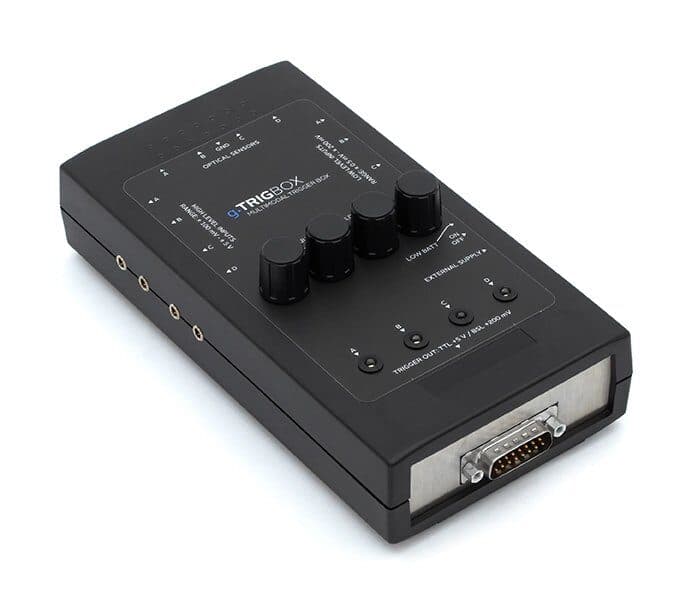
g.TRIGbox

Multimodal trigger box

g.TRIGbox generates trigger pulses from different sensors or input signals, with its input and output lines isolated from each other. The trigger outputs connect to the digital or analogue inputs of data acquisition systems such as g.USBamp, g.HIamp and g.Nautilus, so almost any stimulation in your experimental paradigms is precisely detected and recorded.

  • >4 kV isolation
  • TTL +5 V output
  • 16 experimental conditions
  • g.HIamp · g.USBamp · g.Nautilus
g.TRIGbox multimodal trigger box

Highlights

  • PowerPoint for setting up and presenting stimuli and paradigms
  • >4 kV isolation between trigger inputs and outputs
  • Trigger sources from visual, auditory, electrical or tactile stimulators
  • A threshold set separately for each channel; 4 LEDs confirm correct detection
  • Connects to g.HIamp, g.Nautilus or g.USBamp data acquisition systems
  • Up to 16 experimental conditions on a single coded trigger channel

Technical specifications

Trigger output voltage
TTL +5 V, BSL 200 mV
Input voltage (low level)
±0.5 mV – ±200 mV (4 inputs)
Input voltage (high level)
±100 mV – ±5 V (4 inputs)
Trigger output duration
Minimum 20 ms
Power supply
9 V battery or external power supply
Current consumption
~40 mA
Low battery indicator
~7 V
Isolation voltage
>4 kV (input / output)
Trigger sources

Catches almost any stimulus

Wide support for input signals and sensors means many trigger sources can be used: sound card outputs, microphones, piezoelectric or inductive sensors, response buttons, logic signals from external stimulators (TTL, CMOS and so on), visual markers on a computer screen, LED indicators, strobe lights or slide projectors.

  • Sound & microphone
  • Response buttons
  • TTL / CMOS
  • Screen markers
P300 application

A P300 experiment to identify a culprit

A PowerPoint presentation is prepared with 50 pictures in all, of people the suspect may know (targets) and people they do not (non-targets); about five times as many non-targets as targets is recommended. A visual sensor on the screen detects small black-and-white markers on the slides, and g.TRIGbox produces a TTL trigger pulse at every slide change. The real-time system compares the evoked potentials; the largest P300 response appears for pictures of the people the suspect knows.

  • P300 paradigm
  • PowerPoint
  • Real-time EP analysis
g.tec
Contact

Let's plan your project together.

Talk to our team about device selection, protocol design, installation and software integration. We will work out the technical configuration that best fits your research or clinical goal.

Request a quote

Call us +90 554 381 46 20Serving all of Türkiye · reply within 24 hours on working days