
EEGEEG & TMS
The Core Challenge in TMS-EEG Recording: Artefacts
TMS-EEG is one of the most powerful combined neuroscience approaches for studying brain function. But turning that power into quality data requires hardware optimised specifically for the task — and electrode geometry sits at the centre of that process.
The Fundamentals of TMS-EEG Recording
TMS-EEG integrates two modalities:
- TMS
- Delivers brief, high-intensity magnetic pulses to cortical regions
- EEG
- Records the electrical potentials of the neural populations responding to the pulse
This dual structure lets TMS-EEG recordings measure cortical excitability with high temporal resolution.
Challenges of Simultaneous Stimulation and Recording
During a TMS pulse the coil produces:
- Rapidly changing magnetic fields
- Large induced voltages in nearby conductors
- Mechanical vibrations
- Saturation effects in nearby electronics
These factors create artefacts that must be minimised by design, not by filtering alone. Electrode geometry, materials and integrated electronics directly determine how quickly the EEG signal recovers after stimulation.
Why Electrode Geometry Matters in TMS-EEG
Electrode thickness directly affects coil placement and artefact management.
How Electrode Thickness Affects Artefact Formation
A thick electrode increases the coil–scalp distance, and this:
- Weakens the magnetic field reaching the cortex
- Forces researchers to raise the stimulation intensity
- Leads to larger EEG artefacts
- Reduces the focality of stimulation
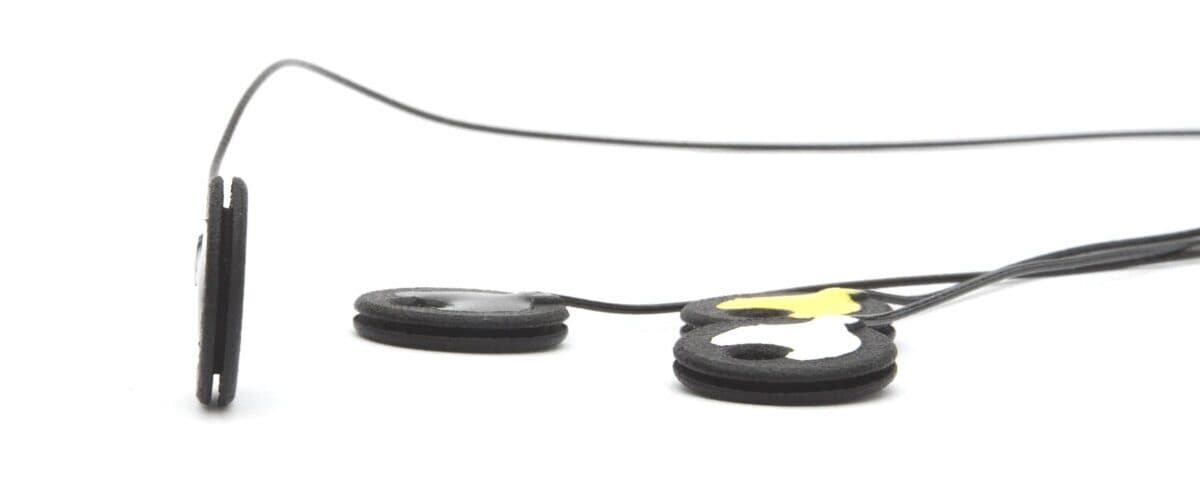
Ultra-Flat Electrode Technology: the 3 mm g.Ladybird
The introduction of 3 mm ultra-flat electrodes represents a major advance in TMS-compatible EEG technology. As the thinnest TMS electrode on the market, this design allows the coil to be positioned extremely close to the scalp. This improves both stimulation precision and EEG quality.
Benefits for TMS Pulse Strength and Crosstalk
By reducing the coil–scalp distance:
- Less stimulation power is needed
- Pulse artefacts shrink
- The electric field distribution becomes more homogeneous
- Coil stability improves in repetitive TMS
Active and Passive Electrode Systems
Active Electrodes
- Strong EEG signals even at higher impedances
- Fast recovery after TMS (<10 ms)
- Reduced sensitivity to environmental noise
Passive Electrodes
- Extremely fast post-pulse recovery
- Minimal risk of amplifier saturation
- Clean recording of early TMS-evoked potentials
Engineering Properties of Sintered Ag/AgCl Electrodes
Sintered silver/silver chloride provides a low noise floor, a stable half-cell potential, resistance to polarisation and excellent performance across 0–10 kHz. Thanks to their dense porous structure, sintered Ag/AgCl electrodes keep performing even under TMS-induced transients and high dynamic range conditions.
Cap Design and Electrode Layout for TMS-EEG
High-density EEG caps such as the g.GAMMAcap³ offer:
- 74 extended 10–20 positions
- 86 optional intermediate positions
- Flexible yet durable fabric
- Easy integration with ultra-flat electrodes
Applications in Clinical and Cognitive Neuroscience
TMS-EEG offers insights into:
- Cortical excitability
- Inhibitory/excitatory balance
- Network connectivity
- Plasticity mechanisms
- Neuromodulation effects
- Depression, stroke, epilepsy
Conclusion
The field of TMS-EEG recording continues to advance through innovations in electrode design, amplifier technology and closed-loop systems. 3 mm ultra-flat electrodes represent a major leap, delivering cleaner data, reduced artefacts and more precise stimulation control. Combined with high-performance amplifiers and dedicated caps, these tools give researchers the stability and accuracy that cutting-edge neurophysiology studies require.